Pizza Connection (1985), Michele Placido and the Desperate Palermo Behind the Mafia
Rewatching Damiano Damiani’s Pizza Connection (1985), starring Michele Placido, I was struck less by the familiar machinery of the mafia thriller than by the Palermo surrounding it. This is not the romantic Sicily of tourist brochures, magnificent churches and Mediterranean light. In the film, Palermo looks practically like a dump: shabby streets, deteriorating buildings, overcrowded neighborhoods and people desperately trying to survive extreme poverty. The city is not simply a location for assassinations and criminal meetings. It is the social world that makes the mafia’s power possible.
That is why I chose this recent photograph of a Palermo alley to accompany the review. The tightly packed buildings, the narrow passage and the sense of lives compressed into a small urban space evoke something of Damiani’s visual world. There is architectural character here, even beauty, but also a claustrophobic intimacy. After seeing the film again, it is hard to look at such streets without imagining the economic hardships endured by generations of their residents. The photograph does not prove anything about the circumstances of people living there today, and contemporary Palermo should not be confused with the Palermo of 1985. It does, however, offer a tangible bridge between the city I recently visited and the one Damiani put on screen.
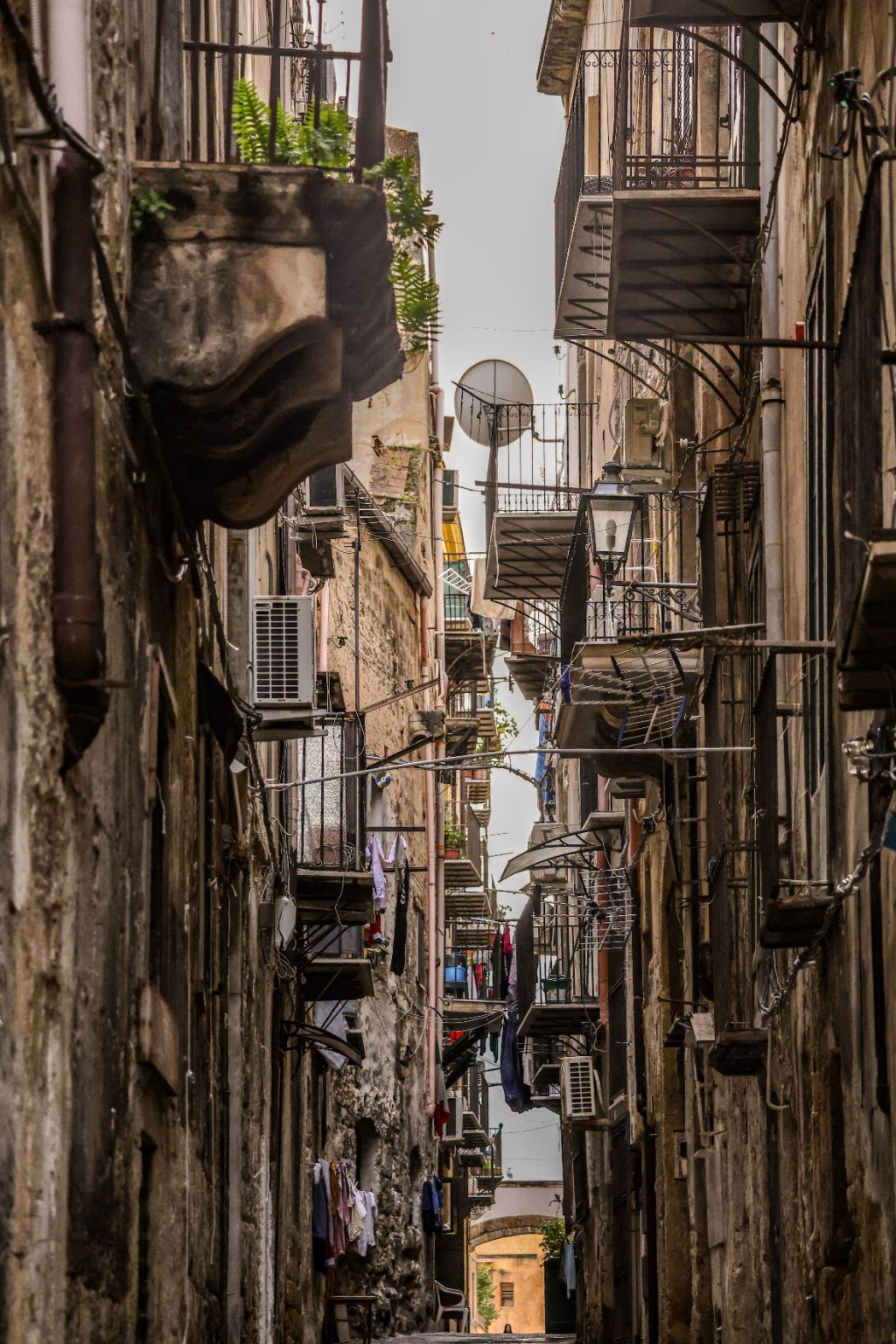
Photograph of Palermo: MediaGallery.org.
Placido plays Mario, a Sicilian emigrant who runs a pizzeria in New York while secretly working as a professional mafia killer. Sent back to Palermo to assassinate a magistrate investigating organized crime, he encounters his younger brother Michele, whose life exposes the gulf between Mario’s acquired wealth and the desperate environment from which he escaped. Mario has money, status and the outward appearance of respectability. His brother lives much closer to the vulnerable world on which criminal organizations prey.
This contrast is essential. Damiani shows a society where poverty is not merely an unfortunate backdrop but a source of dependency. The mafia can offer employment, protection and quick money in places where legitimate opportunities appear painfully scarce. It can also threaten, exploit and discard those who have almost nothing. People do not necessarily enter its orbit because they admire gangsters. Some are simply trying to survive. The film’s grim streets and exhausted atmosphere make this point more persuasively than a speech about economics ever could.
Mario believes he can separate his profession from his private affections. He can kill for his employers and still be a loving older brother. He can participate in a system built on intimidation while imagining that his own family will remain exempt from its consequences. Placido makes this contradiction credible by giving Mario warmth, intelligence and genuine tenderness. He is not a cartoon villain, and that makes him more troubling. His love is real; so is his complicity.
The relationship between Mario and Michele becomes the film’s moral center. The younger brother still possesses a sense of right and wrong that Mario has learned to subordinate to obedience. Mario’s criminal success seems to promise the power to protect his family, but in reality that success has made him dependent on men who can withdraw their protection at any moment. His employers speak the language of loyalty and honor, yet their organization treats human lives as disposable.
There are weaknesses. The film occasionally leans on melodrama, and its opposition between a compromised older brother and a comparatively innocent younger one is sometimes too emphatic. Some supporting characters lack nuance. But the emotional simplicity also gives the story the force of a traditional Italian tragedy: a man discovers that the system that made him powerful has left him remarkably little freedom.
Released in 1985, Pizza Connection belongs to the period when Sicily’s heroin-trafficking networks, their connections to the United States and attacks on Italian magistrates were immediate realities. Damiani had already explored the relationship between mafia power and Sicilian society in The Day of the Owl. Here, the international crime plot provides the structure, but the city’s social conditions supply much of the meaning.
Seen alongside a contemporary series such as Gomorrah, the film feels more conventional in form, but not necessarily more forgiving in its judgment. Both works expose the emptiness of criminal claims to honor and family loyalty. In Pizza Connection, Mario’s tragedy is that he has mistaken his usefulness to the organization for independence. He thinks his money and reputation allow him to stand above the poverty he left behind. In fact, he remains trapped in the same hierarchy of fear, only at a higher level.
The Palermo photograph is therefore more than an atmospheric illustration. It points toward the people outside the central criminal drama: residents of the neighborhoods where the mafia exercises influence, families struggling to get by, young men with limited choices. The film may follow an assassin, but its bleak cityscape keeps reminding us of the much larger population forced to live with the consequences of organized crime.
That is what stayed with me after this rewatch. Not the mechanics of the assassination plot, but the sight of a desperately poor Palermo and the terrible irony of a man who has escaped poverty through murder, only to discover that his success cannot save the person he loves. Pizza Connection remains worth watching because it understands that mafia violence does not exist apart from ordinary society. It grows inside it, feeds on its weaknesses, and eventually destroys even those who believe they have mastered its rules.